The FishAge.org Education Center brings together educational articles, project updates, reference collection insights, and instructional videos
from our team and collaborators.
Share this Post:
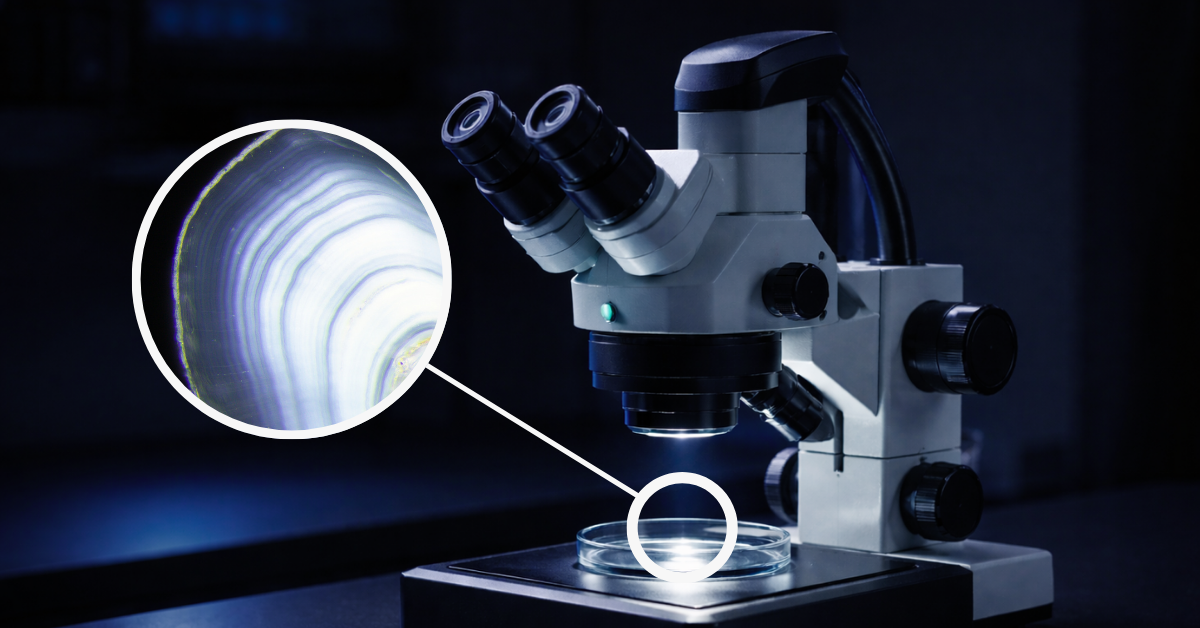
When ageing fish, structures like otoliths and fin spines are viewed under a microscope. One of the most important and often overlooked factors in getting a clear image is illumination.
Clear visualization of growth increments is essential for accurate age estimation. Lighting directly affects how opaque and translucent zones appear, which influences how easily growth patterns can be interpreted. Poor lighting can obscure or distort key features.
There is no single “best” lighting method. Different approaches highlight different structural features, so the goal is to match the lighting to the structure, species, and preparation method.
Below is a quick overview of commonly used lighting modes:
Transmitted Light Passes through the specimen from below. Most commonly used for thin-sectioned otoliths and sectioned fin rays or spines. Differences in density create strong contrast between opaque and translucent zones, making growth increments easier to identify.
Reflected Light Illuminates the specimen from above or at an angle. Emphasizes surface features rather than internal structure.
Oblique Lighting A low-angle form of reflected light. Enhances surface relief and subtle structural differences, improving visibility of faint or edge increments.
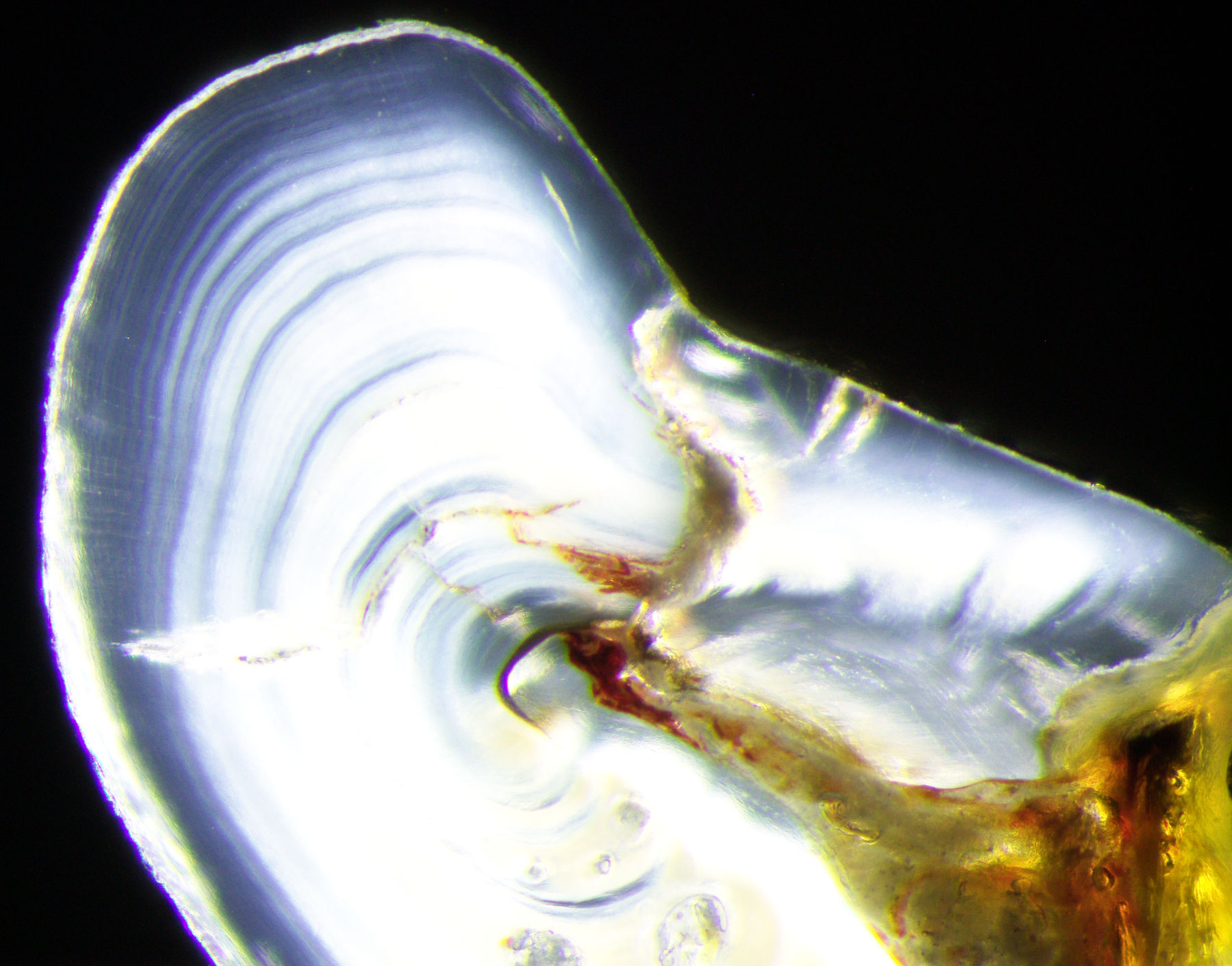
Darkfield Illumination Light is directed at extreme angles so only scattered light enters the lens. Produces a bright specimen against a dark background. Opaque zones appear brighter, while translucent zones appear darker, increasing contrast.
Improving Increment Visibility: Practical Tips
Derek Crane is an Associate Professor at Coastal Carolina University. His lab’s recent research has focused on population biology, ecological modeling, age estimation, and early life history.We are excited to share his practical approaches as an example of effective strategies for using different lighting modes to improve increment visibility. He recommends slowly toggling between lighting modes when examining a new species to determine which settings make increments most visible.
“When working with a species for the first time, I toggle slowly between lighting settings to get a feel for what works best. Darkfield is a good starting point, but adjusting between darkfield and oblique often helps highlight compressed annuli that are otherwise difficult to see.”
In his experience, darkfield often works well for species with strong contrast between opaque and translucent zones, but it is not universally effective. As fish age, outer annuli may become compressed and less distinct. Positioning the turret between darkfield and oblique illumination can improve visibility by increasing light while maintaining contrast.
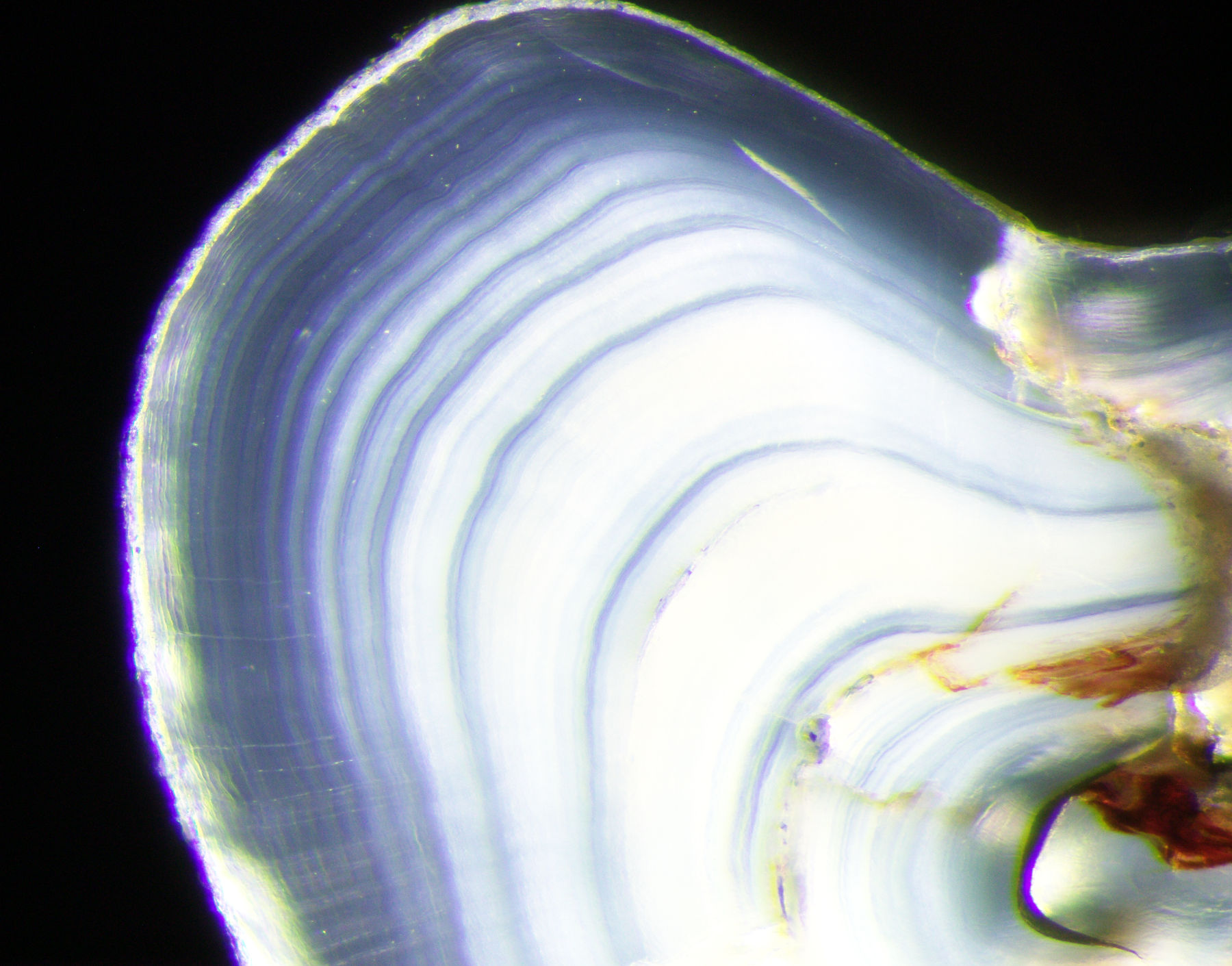
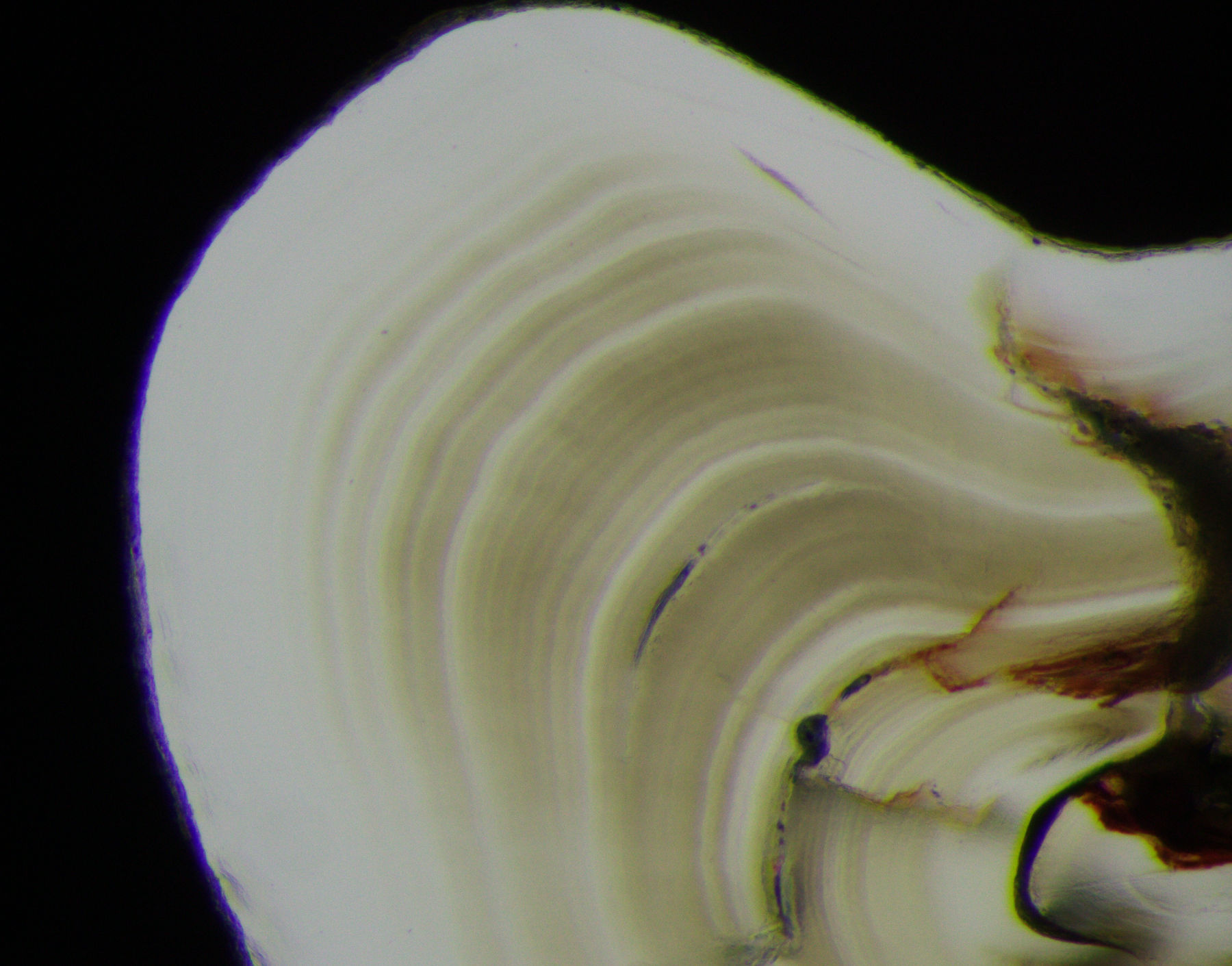
The following images show a pelvic fin ray from a known-age Muskellunge (Age 20; Iowa DNR, East Okoboji Lake, IA), imaged by Derek Crane under varying lighting conditions to demonstrate how adjustments in illumination and orientation improve increment visibility.
Initial view: Blurry image with limited increment definition.
Adjusting orientation: Rotating or flipping the structure improves sharpness and reveals increments.
Darkfield illumination: Good contrast overall, but outer increments remain difficult to distinguish.
Darkfield + oblique: Combining lighting improves contrast and sharpness near the edge.
Transmitted light: Lower contrast makes increments harder to resolve.
These practical adjustments reinforce a central principle in fisheries age estimation: lighting and preparation should be adapted to the specimen rather than following a single fixed protocol. Recent work by Crane and colleagues demonstrates that adapting structure type, preparation, and interpretation methods improves age estimation accuracy and consistency across species (Pfennig et al., 2024; DOI: 10.1002/nafm.10997).
Final Takeaway
Producing clear, reproducible images is at the heart of accurate age estimation. At FishAge, our high-quality images result from a combination of careful specimen preparation and optimized imaging setups. Attention to detail ensures that every structure we analyze is captured clearly and consistently, supporting defensible and precise age readings.
Clear imaging doesn’t just make life easier in the lab; it strengthens fisheries research, population assessments, and management decisions. For labs aiming to improve increment visibility, experimenting with lighting, orientation, and post-processing while applying deliberate, consistent practices can make a meaningful difference in the quality and reliability of age estimates.
Subscribe to get new Education Center posts by email.
When ageing fish, structures like otoliths and fin spines are viewed under a microscope. One of the most important and often overlooked factors in getting a clear image is illumination.
Clear visualization of growth increments is essential for accurate age estimation. Lighting directly affects how opaque and translucent zones appear, which influences how easily growth patterns can be interpreted. Poor lighting can obscure or distort key features.
There is no single “best” lighting method. Different approaches highlight different structural features, so the goal is to match the lighting to the structure, species, and preparation method.
Below is a quick overview of commonly used lighting modes:
Transmitted Light Passes through the specimen from below. Most commonly used for thin-sectioned otoliths and sectioned fin rays or spines. Differences in density create strong contrast between opaque and translucent zones, making growth increments easier to identify.
Reflected Light Illuminates the specimen from above or at an angle. Emphasizes surface features rather than internal structure.
Oblique Lighting A low-angle form of reflected light. Enhances surface relief and subtle structural differences, improving visibility of faint or edge increments.
Darkfield Illumination Light is directed at extreme angles so only scattered light enters the lens. Produces a bright specimen against a dark background. Opaque zones appear brighter, while translucent zones appear darker, increasing contrast.
Improving Increment Visibility: Practical Tips
Derek Crane is an Associate Professor at Coastal Carolina University. His lab’s recent research has focused on population biology, ecological modeling, age estimation, and early life history.We are excited to share his practical approaches as an example of effective strategies for using different lighting modes to improve increment visibility. He recommends slowly toggling between lighting modes when examining a new species to determine which settings make increments most visible.
“When working with a species for the first time, I toggle slowly between lighting settings to get a feel for what works best. Darkfield is a good starting point, but adjusting between darkfield and oblique often helps highlight compressed annuli that are otherwise difficult to see.”
In his experience, darkfield often works well for species with strong contrast between opaque and translucent zones, but it is not universally effective. As fish age, outer annuli may become compressed and less distinct. Positioning the turret between darkfield and oblique illumination can improve visibility by increasing light while maintaining contrast.
The following images show a pelvic fin ray from a known-age Muskellunge (Age 20; Iowa DNR, East Okoboji Lake, IA), imaged by Derek Crane under varying lighting conditions to demonstrate how adjustments in illumination and orientation improve increment visibility.
Initial view: Blurry image with limited increment definition.
Adjusting orientation: Rotating or flipping the structure improves sharpness and reveals increments.
Darkfield illumination: Good contrast overall, but outer increments remain difficult to distinguish.
Darkfield + oblique: Combining lighting improves contrast and sharpness near the edge.
Transmitted light: Lower contrast makes increments harder to resolve.
These practical adjustments reinforce a central principle in fisheries age estimation: lighting and preparation should be adapted to the specimen rather than following a single fixed protocol. Recent work by Crane and colleagues demonstrates that adapting structure type, preparation, and interpretation methods improves age estimation accuracy and consistency across species (Pfennig et al., 2024; DOI: 10.1002/nafm.10997).
Final Takeaway
Producing clear, reproducible images is at the heart of accurate age estimation. At FishAge, our high-quality images result from a combination of careful specimen preparation and optimized imaging setups. Attention to detail ensures that every structure we analyze is captured clearly and consistently, supporting defensible and precise age readings.
Clear imaging doesn’t just make life easier in the lab; it strengthens fisheries research, population assessments, and management decisions. For labs aiming to improve increment visibility, experimenting with lighting, orientation, and post-processing while applying deliberate, consistent practices can make a meaningful difference in the quality and reliability of age estimates.
The FishAge.org Education Center brings together educational articles, project updates, reference collection insights, and instructional videos from our team and collaborators.
Share this Post:
Subscribe to get new Education Center posts by email.