The FishAge.org Education Center brings together educational articles, project updates, reference collection insights, and instructional videos
from our team and collaborators.
Share this Post:
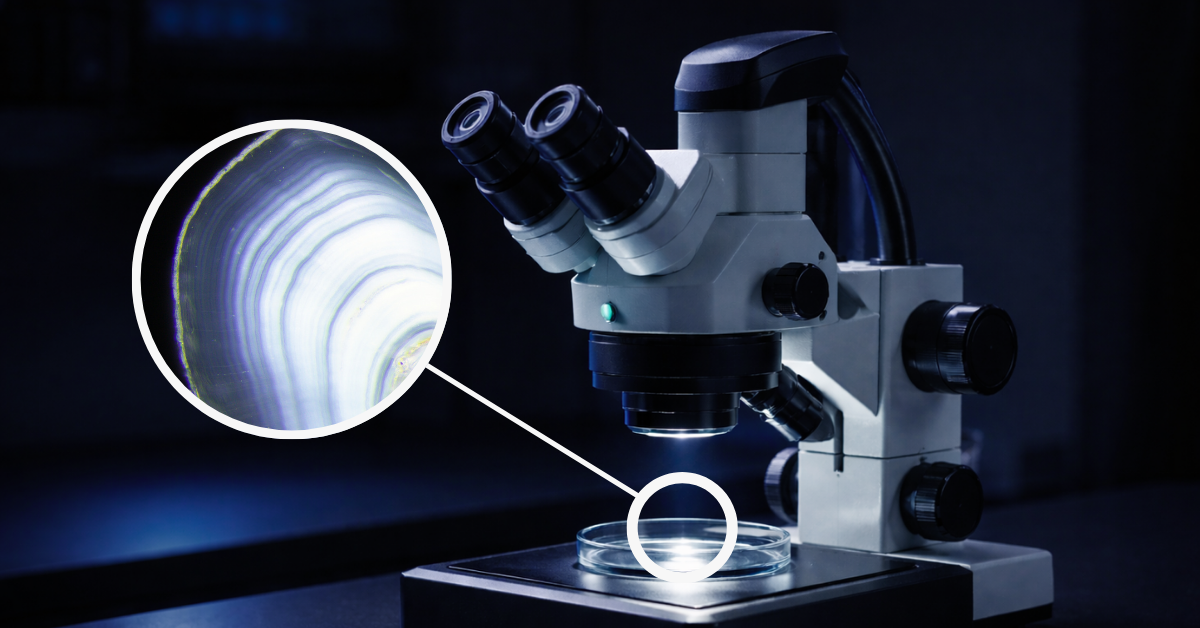
We’re excited to share something new on FishAge.org: a full collection of sectioned otolith images from known-age Lake Trout (Salvelinus namaycush) collected from Lake Ontario!
This collection adds another piece to the growing library of validated fish aging material available to the research community. Each otolith in this set comes from a fish of known age, meaning it’s a valuable reference for anyone training readers, testing interpretation accuracy, or comparing methods across labs and species.
USGS science staff (GLSC; Ann Arbor, Michigan) and vessel crewmembers (GLSC; Cheboygan, Michigan) picking lake trout (Salvelinus namaycush) out of a gillnet during the 2023 Lake Michigan Northern Refuge lake trout spawner survey aboard the GLSC’s R/V Sturgeon. Photo credit: Ben Leonhardt, USGS.
Study Spotlight
The Lake Ontario Lake Trout collection featured here comes from a study by Osborne et al. published in the North American Journal of Fisheries Management (DOI: 10.1002/nafm.10726).
The study revealed that while readers showed good overall precision (with an average coefficient of variation around 8–9%), their accuracy varied considerably. Exact matches to true age ranged from about 42% to 54%, and most readers were within ±1 year for roughly 80% of fish. Age interpretation errors depended on age, where readers tended to overestimate younger fish and underestimate older ones.
The team also noted that certain otolith features caused confusion, like faint early annuli or checks that looked like true rings. These visual challenges make Lake Trout an especially tricky species to age consistently, even among experienced readers.
Ultimately, Osborne et al. emphasized that accessible reference collections of known-age otoliths are vital for improving accuracy, training new readers, and monitoring bias across time and labs. This is exactly what FishAge.org is designed to support.
You can now view high-resolution sectioned otolith images from all Lake Trout, complete with metadata such as known age, year class, fish length and weight, and sex.
Do you have known-age fish structures or a validation study to share?
Do you have known-age fish structures or a validation study to share
We’d love to feature them! If you have known-age fish structures (otoliths, scales, fin rays, etc.) or an age validation paper you’d like highlighted on our blog, please Contact Us!
Subscribe to get new Education Center posts by email.
We’re excited to share something new on FishAge.org: a full collection of sectioned otolith images from known-age Lake Trout (Salvelinus namaycush) collected from Lake Ontario!
This collection adds another piece to the growing library of validated fish aging material available to the research community. Each otolith in this set comes from a fish of known age, meaning it’s a valuable reference for anyone training readers, testing interpretation accuracy, or comparing methods across labs and species.
USGS science staff (GLSC; Ann Arbor, Michigan) and vessel crewmembers (GLSC; Cheboygan, Michigan) picking lake trout (Salvelinus namaycush) out of a gillnet during the 2023 Lake Michigan Northern Refuge lake trout spawner survey aboard the GLSC’s R/V Sturgeon. Photo credit: Ben Leonhardt, USGS.
Study Spotlight
The Lake Ontario Lake Trout collection featured here comes from a study by Osborne et al. published in the North American Journal of Fisheries Management (DOI: 10.1002/nafm.10726).
The study revealed that while readers showed good overall precision (with an average coefficient of variation around 8–9%), their accuracy varied considerably. Exact matches to true age ranged from about 42% to 54%, and most readers were within ±1 year for roughly 80% of fish. Age interpretation errors depended on age, where readers tended to overestimate younger fish and underestimate older ones.
The team also noted that certain otolith features caused confusion, like faint early annuli or checks that looked like true rings. These visual challenges make Lake Trout an especially tricky species to age consistently, even among experienced readers.
Ultimately, Osborne et al. emphasized that accessible reference collections of known-age otoliths are vital for improving accuracy, training new readers, and monitoring bias across time and labs. This is exactly what FishAge.org is designed to support.
You can now view high-resolution sectioned otolith images from all Lake Trout, complete with metadata such as known age, year class, fish length and weight, and sex.
Do you have known-age fish structures or a validation study to share?
Do you have known-age fish structures or a validation study to share
We’d love to feature them! If you have known-age fish structures (otoliths, scales, fin rays, etc.) or an age validation paper you’d like highlighted on our blog, please Contact Us!
The FishAge.org Education Center brings together educational articles, project updates, reference collection insights, and instructional videos from our team and collaborators.
Share this Post:
Subscribe to get new Education Center posts by email.